
 USA
 Malaysia
 Spanish
 Thailand
 Indonesia
 India
In the world of industrial power, compressed air is often referred to as the “fourth utility.” However, unlike electricity or natural gas, the quality of your compressed air is entirely dependent on how you treat it after it leaves the compressor. The greatest enemy of any compressed air system isn’t mechanical wear—it is water.
Atmospheric air naturally contains moisture in the form of water vapor. When that air is compressed, the vapor concentrates, eventually condensing into liquid water that can wreak havoc on your operations. To combat this, facilities rely on two primary technologies: refrigerated air dryers and desiccant air dryers. Choosing between them is one of the most critical decisions in industrial air system maintenance, as the wrong choice can lead to contaminated products, corroded pipes, and expensive downtime.
This guide will break down the functional differences, performance capabilities, and ideal applications for each to help you select the best fit for your facility.
Why Moisture Control Matters in Compressed Air Systems
When air is compressed, its temperature rises significantly, allowing it to hold a high volume of water vapor. As that air moves through your piping and cools down, that vapor turns into liquid condensate. Without an air dryer for air compressor systems, this water travels through your entire plant.
The risks of untreated moisture include:
- Corrosion: Water leads to rust inside expensive piping and storage tanks.
- Equipment Damage: Liquid water washes away essential lubricants inside pneumatic tools, control valves, and actuators, leading to premature failure.
- Bacterial Growth: In industries like food processing or pharmaceuticals, moisture creates a breeding ground for microorganisms.
- Product Contamination: Moisture can ruin paint finishes, clump powdered ingredients, or short-circuit sensitive electronics.
Reliable compressed air moisture removal is not a luxury; it is a fundamental requirement for maintaining system integrity and reducing the “maintenance tax” on your downstream equipment.
How Refrigerated Air Dryers Work
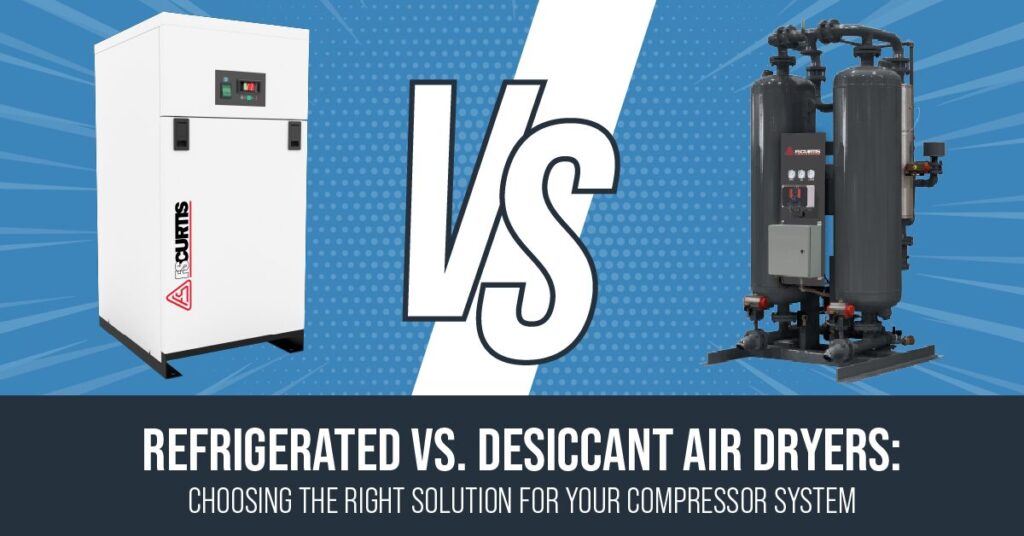
A refrigerated air dryer operates on the same principle as a home refrigerator or air conditioner. It pulls the warm, moist compressed air into a heat exchanger where it is cooled by a refrigerant circuit.
As the air cools, the water vapor condenses into liquid droplets, which are then captured by a moisture separator and discharged through an automatic drain. The dry, cold air is then reheated before entering the plant lines to prevent “sweating” on the outside of the pipes.
Key Characteristics:
- Dew Point: Typically provides a Pressure Dew Point (PDP) of 35°F to 50°F. This means water will not condense unless the air temperature drops below that range.
- Types: Available as non-cycling (runs constantly) or cycling (shuts off or throttles when demand is low to save energy).
- Ideal For: General manufacturing, automotive shops, and indoor applications where the ambient temperature always remains above freezing. They are cost-effective, have a low pressure drop, and require minimal maintenance.
How Desiccant Air Dryers Work
When a facility requires “ultra-dry” air, a desiccant air dryer is the necessary solution. Rather than using cold temperatures to condense water, these dryers use a process called adsorption.
The compressed air passes through a vessel filled with hygroscopic beads (typically activated alumina or silica gel). These beads act like a sponge, attracting and holding water molecules on their surface. Most desiccant dryers utilize a “twin tower” design: one tower dries the air while the other “regenerates” by purging the collected moisture using either a small portion of dry compressed air (heatless) or an external heat source (heated).
Key Characteristics:
- Dew Point: Capable of reaching extremely low dew points, typically -40°F, and in some specialized cases, as low as -100°F.
- Necessity: Essential for outdoor piping in cold climates where pipes might freeze, or for “Class 1” air purity requirements.
- Ideal For: Food and beverage, pharmaceuticals, electronics manufacturing, and chemical processing. While they have a higher initial cost and higher energy consumption due to the “purge air” requirement, they provide the highest level of compressed air treatment.
Comparing Refrigerated and Desiccant Dryers: What’s Right for You?
The “best” dryer depends entirely on your specific application and the environment of your facility. Use the comparison below to weigh your options:
| Feature | Refrigerated Air Dryer | Desiccant Air Dryer |
| Pressure Dew Point | 35°F to 50°F | -40°F to -100°F |
| Initial Cost | Lower | Higher |
| Energy Consumption | Low (Especially Cycling models) | Higher (Due to Purge/Heat) |
| Maintenance Burden | Minimal (Clean condensers/drains) | Moderate (Replace desiccant/valves) |
| Best Environment | Ambient temperature-controlled | Cold climates / Outdoor piping |
| Typical Use Case | General shop air / Pneumatic tools | Food/Pharma / Lab / High-Purity |
Real-World Scenario: If your facility is located in a humid climate but the piping is entirely indoors at 70°F, a refrigerated dryer is usually sufficient. However, if those same pipes run across a roof or through an unheated warehouse in the winter, you must use a desiccant dryer to prevent the lines from freezing solid.
5 Questions to Ask Before Choosing a Dryer
Before making a final selection, walk through this checklist to gain clarity on your operational needs:
- What dew point does my process require? Check the technical manuals for your most sensitive downstream equipment. If it requires “instrument air,” you likely need a desiccant solution.
- What are my lowest operating temperatures? If your air lines ever reach temperatures below 35°F, a refrigerated dryer will not prevent freezing.
- What is my flow (SCFM), pressure (PSIG), and how does it vary? Sizing a dryer correctly for your maximum flow is critical to prevent “moisture carryover.”
- How critical is air purity to my end product? If air touches a product people consume or an electronic component, the cost of a desiccant dryer is minor compared to the cost of a product recall.
- What are my maintenance and energy budget expectations? Are you prepared for the higher energy “purge” costs of a desiccant dryer, or is a high-efficiency cycling refrigerated dryer better for your bottom line?
How FS-Curtis Dryer Solutions Align with Your Needs
FS-Curtis offers a comprehensive lineup of air treatment solutions, ranging from simple, compact units for small shops to high-capacity, energy-saving systems for large industrial plants.
Based on the industrial air treatment page and available models, here are the key dryer series highlighted by their functional and performance benefits:
Refrigerated Dryers (Standard & Energy Saving)
These models are ideal for general manufacturing where a consistent 35°F to 50°F dew point is sufficient.
- RES Series: The “Energy Saving” cycling series. These use Phase Change Material (PCM) to store thermal energy, allowing the refrigeration compressor to cycle off during low demand. This significantly reduces power costs for facilities with varying air usage.
- RNHI Series: Specifically engineered for high inlet temperatures (up to 180°F). These are often paired with reciprocating compressors that don’t have an aftercooler, as they combine an aftercooler, separator, dryer, and filter into one unit.
- RN Series: A non-cycling series designed for simplicity and reliability. These are compact units perfect for smaller footprints.
Desiccant Dryers (Ultra-Dry Air)
For critical applications requiring dry air or protection against freezing temperatures (dew points down to -40°F or -100°F).
- FS-Curtis DA Series: A modular desiccant series often used for paint spraying and other point-of-use applications. Its modular design allows it to scale easily with your system.
- D Series (DL/DHP/DHB): Large-scale regenerative dryers including heatless (DL), heated purge (DHP), and blower purge (DHB) versions. These handle flows up to 5,400 SCFM for heavy industrial processes.
Find The Right Dryer For Your Industry Needs
Choosing between refrigerated and desiccant technologies is a balance of moisture control, energy efficiency, and equipment longevity. While refrigerated dryers are the standard for general industrial use, desiccant dryers are the essential shield for critical, high-purity applications.
Ready to eliminate moisture from your system for good? Find your local FS-Curtis distributor today for sizing assistance or to explore our full line of dryer solutions.